1958: The Year A Cat Explained Interior Design
Your visual system does not really see surfaces. It sees edges. It is not a metaphor, and it is not an opinion about taste. It was measured, in a laboratory, with a wire and an anaesthetised cat, nearly seventy years ago.
A cell that would not respond
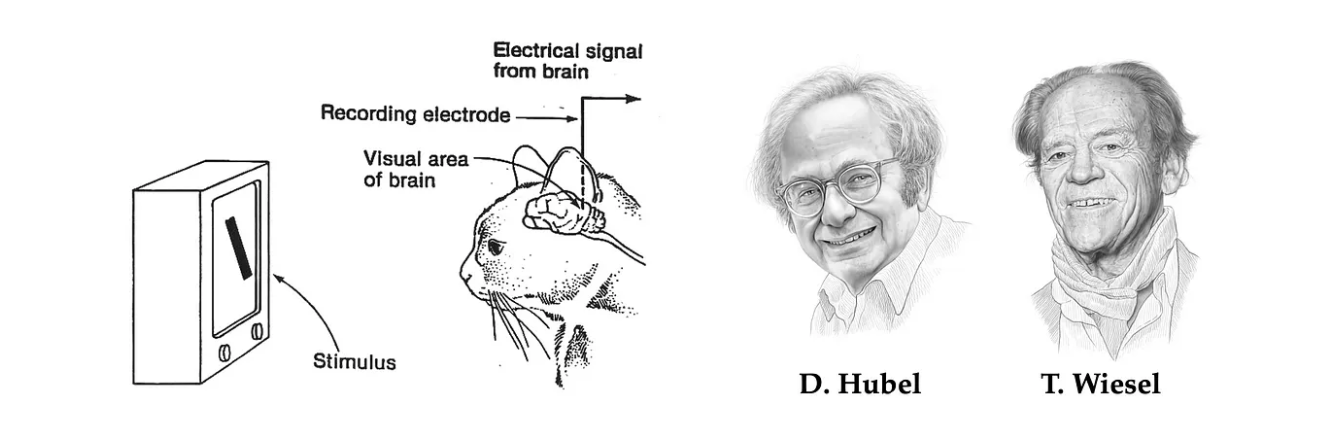
In 1958, two young researchers at Johns Hopkins, David Hubel and Torsten Wiesel, were trying to find out what makes a single brain cell in the visual cortex fire.
The method was patient and unglamorous. They placed a fine electrode next to one neurone, projected an image onto a screen in front of the animal's eye, and listened. When the cell fired, it produced an audible click through a loudspeaker.
The prevailing assumption was that a cell in the visual cortex would respond to a spot of light, the way cells in the retina do. So they projected spots of light. Bright spots, dim spots, spots in every position on the screen. The cell stayed silent. Hour after hour.
Then, changing the glass slide in the projector, they slid one plate out and another in. As it moved, the faint shadow of the slide's straight edge swept across the screen.
The loudspeaker went off like a machine gun.
The brain has a department for edges
What Hubel and Wiesel had found, almost by accident, is that the cells of the visual cortex are not interested in illumination. They are interested in boundaries.
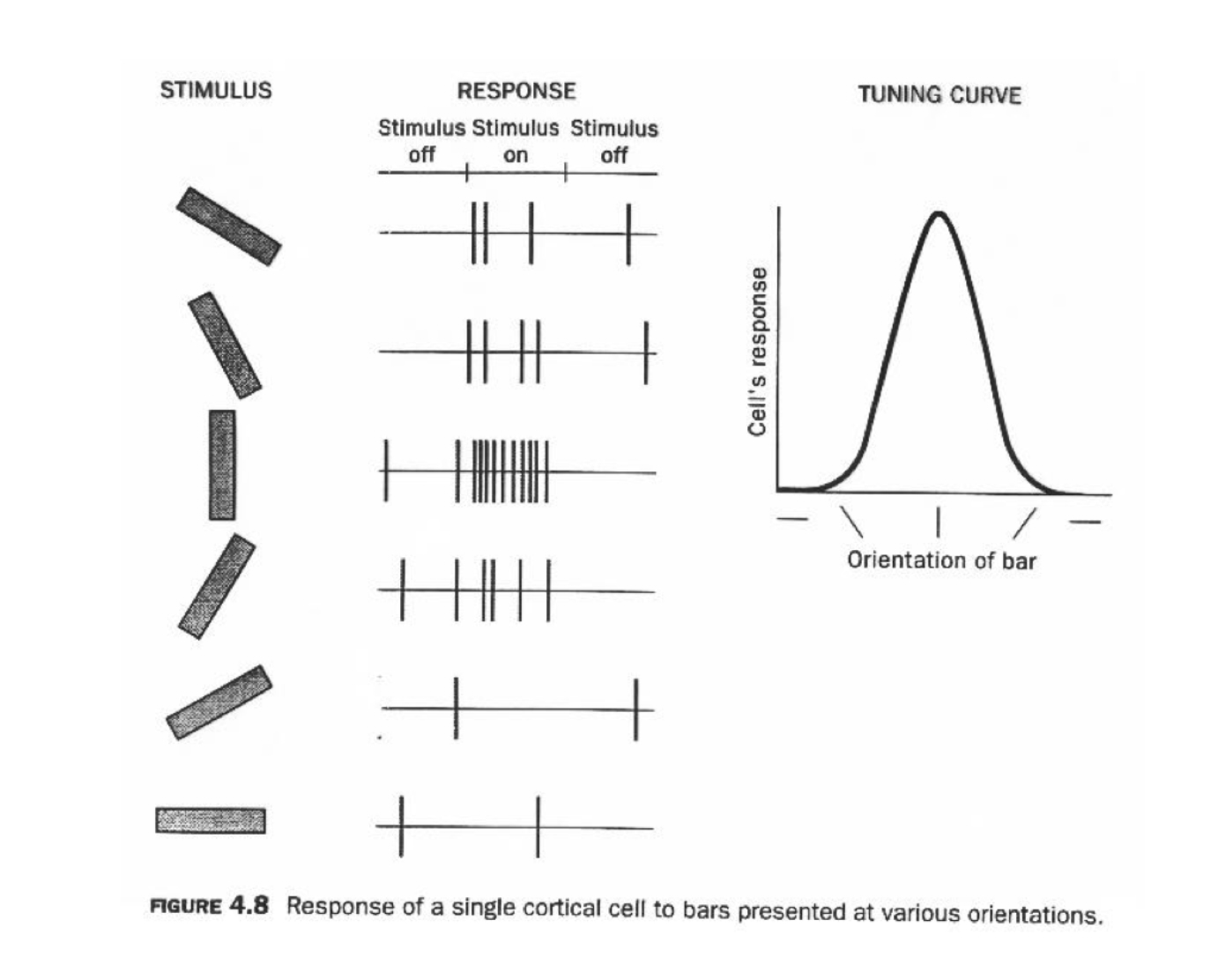
A single cell will ignore a bright field entirely and then fire violently when a straight edge crosses its patch of the world at one particular angle. Rotate that edge twenty degrees and the cell falls quiet again. There are cells for vertical, cells for horizontal, cells for every orientation in between, arranged in orderly columns through the cortex.
An extraordinary amount of the brain's most expensive tissue is committed to this one task: finding the line where one thing ends and another begins, and reporting its angle. The work took more than twenty years to complete. In 1981 it took the Nobel Prize in Physiology or Medicine.
It is worth being precise about what this means, because it is easy to draw the wrong conclusion. It does not mean edges are bad. Edges are how we perceive anything at all. Without edge detection there is no object, no depth, no form — only a wash of brightness.
It means something narrower and more useful. It means the eye is not neutral about boundaries. It arrives at a room already hunting for them, and it finds them before the conscious mind has decided what is worth looking at.
The line nobody chose
Consider what this implies for a room.
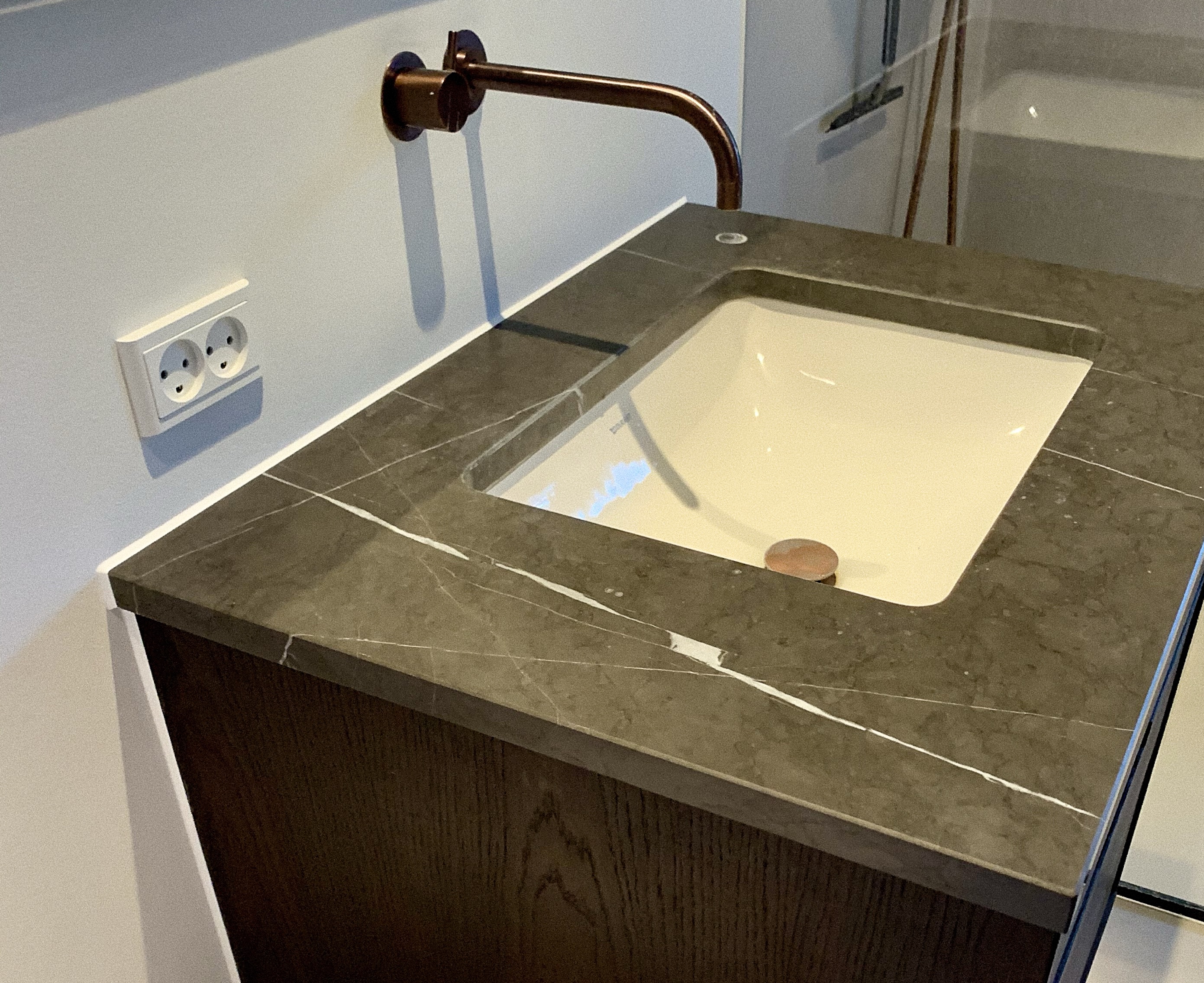
A stone worktop meeting a painted wall produces a boundary. So does a wall meeting a floor, a cabinet meeting a plinth, a basin meeting its surround. These transitions are unavoidable. The architect designed them, the fabricator executed them, and they belong to the room.
Then there is the sealant.
A standard white cartridge, run into that transition, introduces a second boundary directly on top of the first — a bright, uniform band of a material that appears nowhere else in the space. Two new edges, one on each side of it. High contrast against a dark stone. Perfectly straight, perfectly consistent, running the entire length of the counter.
Everything about it is optimised for the cortex to find.
This is why the silicone line is the detail clients notice without being able to say why they noticed it. It is not that they are looking for it. It is that a large part of their visual system is built to look for exactly that, and it has no way of knowing that this particular line was never a design decision. It was a consequence — of a tube that was on the van, in the colour the wholesaler stocks.
The room contains a hundred deliberate transitions and one accidental one, and the accidental one is the one shaped most like what the brain is hunting for.
Working with the cortex rather than against it
We are not trying to remove the boundary. That is neither possible nor desirable — the transition has to exist, and the eye needs it to read the room correctly.
We are trying to make the boundary belong to the same visual argument as everything around it. That means a tone developed against the actual material, in the light it will live in, at the distance it will be viewed from. It means accounting for the fact that a seam is a recess, that light gathers in it differently, and that the correct colour on a chip is frequently the wrong colour in the room. It means recognising that a transition can carry depth, or particulate structure, or a shadow that lets it settle back rather than step forward.

Hubel and Wiesel were not thinking about interior design. They were trying to understand how a brain builds an image of the world.
But they established something that anyone working with materials should probably know, and almost nobody does: the line between two surfaces is not a minor part of what is seen. Physiologically, it is close to the main event.
Which is a reasonable argument for choosing it on purpose.